
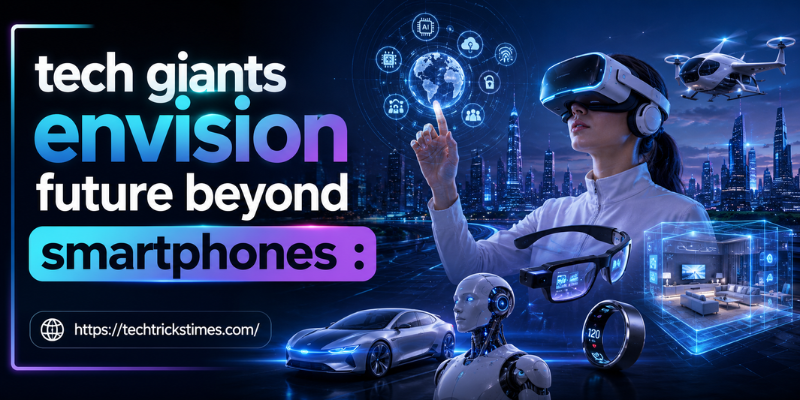

Tech giants envision future beyond smartphones as the next era of technology rapidly takes shape. For over a decade, smartphones have been the center of our digital lives, but leading technology companies now believe the future will extend far beyond handheld devices. Artificial intelligence, wearable technology, augmented reality, mixed reality, and smart ecosystems are becoming the foundation of tomorrow’s connected world. Understanding these innovations helps consumers prepare for a major shift in how they communicate, work, learn, and experience everyday life.
Why Tech Giants Envision Future Beyond Smartphones
The smartphone revolution transformed society, but every major technology eventually reaches maturity. Today, companies are looking toward devices and experiences that feel more natural, intelligent, and immersive.
Several reasons explain why industry leaders are investing in technologies beyond smartphones:
- AI has become significantly more capable.
- Wearable devices continue improving every year.
- Consumers demand more seamless digital experiences.
- Voice assistants are becoming increasingly intelligent.
- Mixed reality is opening entirely new possibilities.
- Smart homes and connected ecosystems are growing rapidly.
Rather than replacing smartphones overnight, these innovations aim to reduce our dependence on constantly looking at a screen.
Artificial Intelligence Is Becoming the New Digital Interface
Artificial intelligence is expected to become the primary way people interact with technology.
Instead of opening apps and typing commands, users may simply speak naturally or allow AI assistants to anticipate their needs.
Future AI systems could:
- Schedule appointments automatically
- Answer complex questions instantly
- Translate conversations in real time
- Summarize emails and meetings
- Manage travel plans
- Personalize entertainment recommendations
- Handle repetitive daily tasks
Generative AI is already changing how people search for information, create content, and complete work. Future devices may rely on AI as their operating system rather than traditional app-based interfaces.
Smart Glasses Could Replace Many Smartphone Functions
One of the biggest areas receiving investment is smart glasses.
Unlike traditional smartphones, smart glasses allow digital information to appear directly within the user’s field of vision.
Potential features include:
- Turn-by-turn navigation
- Live language translation
- Real-time notifications
- Video recording
- Hands-free communication
- AI-powered personal assistants
- Object recognition
Instead of pulling a phone from your pocket, users could simply glance at information displayed through lightweight glasses.
As display technology improves, smart glasses may become practical for everyday use.
Spatial Computing Is Creating More Immersive Experiences
Spatial computing combines augmented reality (AR), virtual reality (VR), and mixed reality (MR) into one interactive environment.
Rather than viewing content on a flat screen, users interact with digital objects placed naturally within physical spaces.
Possible applications include:
Virtual Workspaces
Employees could work with multiple floating displays without requiring physical monitors.
Education and Training
Students may explore historical events, scientific models, or engineering simulations in fully interactive environments.
Healthcare
Doctors could visualize patient scans in 3D while performing complex procedures.
Retail
Customers might preview furniture inside their homes before making purchases.
Entertainment
Gaming and media experiences become significantly more immersive through mixed reality.
Wearable Technology Is Becoming Smarter Every Year
Wearables have evolved well beyond basic fitness tracking.
Modern wearable technology now includes:
- Smartwatches
- Health monitoring devices
- Smart rings
- Wireless earbuds
- Smart glasses
- Medical sensors
Future wearables may continuously monitor:
- Heart health
- Blood pressure
- Body temperature
- Stress levels
- Hydration
- Blood glucose (non-invasive)
- Sleep quality
These health insights could help users detect medical conditions much earlier than traditional methods.
Voice Interfaces May Replace Touchscreens
Typing on small displays isn’t always convenient.
Natural voice interaction is becoming increasingly accurate thanks to AI language models.
Future devices could allow users to:
- Send messages verbally
- Search the web conversationally
- Control smart homes
- Manage calendars
- Shop online
- Receive personalized recommendations
Voice may become one of the primary methods for interacting with digital devices.
Smart Ecosystems Will Connect Everything
Technology companies are no longer building isolated products.
Instead, they’re creating connected ecosystems where devices communicate seamlessly.
A future ecosystem could include:
- Smart home appliances
- Wearable devices
- Autonomous vehicles
- AI assistants
- Smart displays
- Home robots
- Health monitoring systems
Information would synchronize automatically, creating a smoother digital experience.
Robotics Could Become Everyday Companions
Home robotics is another rapidly advancing field.
Future personal robots may assist with:
- Cleaning
- Home security
- Elderly care
- Child assistance
- Grocery management
- Deliveries
- Personal scheduling
Powered by advanced AI, these robots could perform meaningful household tasks rather than following simple programmed instructions.
Sustainability Is Influencing Future Device Design
Environmental concerns are changing how technology products are designed.
Manufacturers increasingly focus on:
- Recycled materials
- Energy efficiency
- Modular repairs
- Longer software support
- Reduced electronic waste
- Sustainable packaging
Future devices may last considerably longer while reducing environmental impact.
Challenges Facing a Post-Smartphone Future
Although innovation is accelerating, several challenges remain.
Privacy Concerns
Always-connected AI devices raise questions about personal data collection and security.
Battery Technology
Smaller wearable devices require longer battery life without increasing size.
Cost
New technologies often launch with premium pricing before becoming affordable.
Consumer Adoption
People are comfortable using smartphones, so replacing established habits will take time.
Regulations
Governments worldwide continue developing policies around AI, digital privacy, and emerging technologies.
Which Tech Giants Are Driving This Transformation?
Several leading companies are investing heavily in the technologies shaping the future beyond smartphones.
Their areas of focus include:
- Artificial intelligence
- Mixed reality
- Wearable devices
- Spatial computing
- AI assistants
- Autonomous technologies
- Smart ecosystems
- Semiconductor innovation
Competition among these companies continues accelerating innovation across the technology industry.
Will Smartphones Completely Disappear?
Probably not—at least not anytime soon.
History shows that new technologies often complement existing ones before eventually replacing them.
For example:
- Desktop computers still exist.
- Laptops remain popular.
- Tablets found their own market.
- Smartwatches complement smartphones.
Similarly, smartphones may gradually become central hubs while wearable devices and AI assistants handle many everyday interactions.
The transition is likely to occur over many years rather than overnight.
What Consumers Should Expect Over the Next Decade
The coming years may introduce remarkable innovations such as:
- AI-powered digital companions
- Lightweight smart glasses
- Advanced health wearables
- Personalized AI assistants
- Seamless smart homes
- Intelligent transportation
- Spatial computing workspaces
- Context-aware computing
Technology will increasingly become invisible, proactive, and deeply integrated into everyday life.
Rather than constantly demanding attention, future devices may quietly assist users whenever needed.
Frequently Asked Questions
What does “tech giants envision future beyond smartphones” mean?
It refers to major technology companies investing in AI, wearable devices, smart glasses, spatial computing, and connected ecosystems that may reduce our reliance on traditional smartphones.
Will smartphones become obsolete?
Not immediately. Smartphones are expected to remain important for years, but many everyday tasks may gradually shift to wearable technology and AI-powered devices.
Which technologies are most likely to replace smartphones?
Smart glasses, AI assistants, wearable devices, mixed reality headsets, voice interfaces, and spatial computing platforms are considered the strongest candidates.
Why is artificial intelligence so important in future devices?
AI enables more natural interactions, personalized experiences, automation, predictive assistance, and conversational interfaces that reduce dependence on traditional apps.
How will consumers benefit from technology beyond smartphones?
Consumers can expect greater convenience, hands-free computing, better health monitoring, immersive entertainment, improved productivity, and smarter connected ecosystems.
Conclusion
Tech giants envision future beyond smartphones because technology is entering an exciting new phase driven by artificial intelligence, wearable devices, spatial computing, and connected ecosystems. While smartphones will remain valuable for years, the next generation of digital experiences will likely become more intelligent, immersive, and seamlessly integrated into everyday life. Staying informed about these emerging trends helps consumers prepare for the future of personal technology.
Stay in touch to get more updates & alerts on techtrickstimes.com! Thank you